


Nursing Home Abuse Lawyer Colorado Springs
If you’ve placed a loved one in a nursing home in Colorado Springs and something feels wrong, you may want to listen to this suspicion. If your relative has not been acting like themselves, then something could be awry.
Our Colorado Springs, CO nursing home abuse lawyer has handled these cases for over 20 years. At Ganderton Law Personal Injury Law Firm, Founder David Ganderton understands the harm that can happen when a facility violates the trust that family members placed in their care. We offer free and confidential consultations, so please reach out now for immediate support.
Why Choose Ganderton Law Personal Injury Law Firm for Nursing Home Abuse in Colorado Springs, CO?
David Ganderton’s Record and Recognition
David Ganderton has been practicing personal injury law in Colorado Springs for more than two decades. He’s licensed with the Colorado State Bar, Wyoming State Bar, and Florida State Bar, and holds membership in the Denver and El Paso Bar Associations. The National Trial Lawyers recognized him as a Top 100 Trial Lawyer. Colorado Springs Gazette readers have voted him “Best Personal Injury Attorney,” “Best Lawyer,” and “Best Law Firm” in the Best of the Springs Awards.
Attorney Ganderton received his J.D. from Stetson University College of Law and B.S. from Florida State University. Both his education and decades of experience handling personal injury cases makes him acutely aware of what can happen to innocent people and how to pursue justice and fair compensation for what they have been through. If you suspect a loved one has been mistreated with their nursing home care, now is the time to reach out for further guidance.
Results for Colorado Families
Ganderton Law Personal Injury Law Firm has helped clients recover millions of dollars, including a $2.25 million recovery in a motorcycle accident, $350,000 for a slip and fall involving spinal surgery, and $335,000 in a case involving a traumatic brain injury. While nursing home abuse cases carry their own distinct legal framework, this track record reflects a firm that builds strong cases and fights for full value. Attorney Ganderton and his team are dedicated to getting results for those who have been wronged due to negligent or careless behavior and sustained significant injury because of it.
As a personal injury lawyer in Colorado Springs, CO, David has represented victims and their families across a wide range of injury-based claims, including premises liability and catastrophic injury, which can be closely parallel the types of injuries nursing home residents sustain when incidents of abuse or mistreatment have occurred.
No Fees Unless We Win
We work on a contingency fee basis, which means that you pay nothing upfront. If we don’t recover compensation for your family, then you don’t owe us anything. You can pursue justice without worrying about legal costs while you’re already dealing with an overwhelming situation. We believe this allows families to get the legal assistance they need without the added stress of more expenses they didn’t expect.
Satisfied Clients
⭐⭐⭐⭐⭐
“I have known David personally for a couple of years and had the privilege of working on cases with him. David and Ganderton Law Personal Injury Law Firm are hands down the best attorneys for your personal injury/medical malpractice concerns. Their personal service is unlike any other firm in Colorado Springs. They will treat you and your case as a priority. I cannot recommend them enough.” — Lori Barkus
Read more reviews on our Google Business Profile.
Types of Nursing Home Abuse Cases We Handle in Colorado Springs
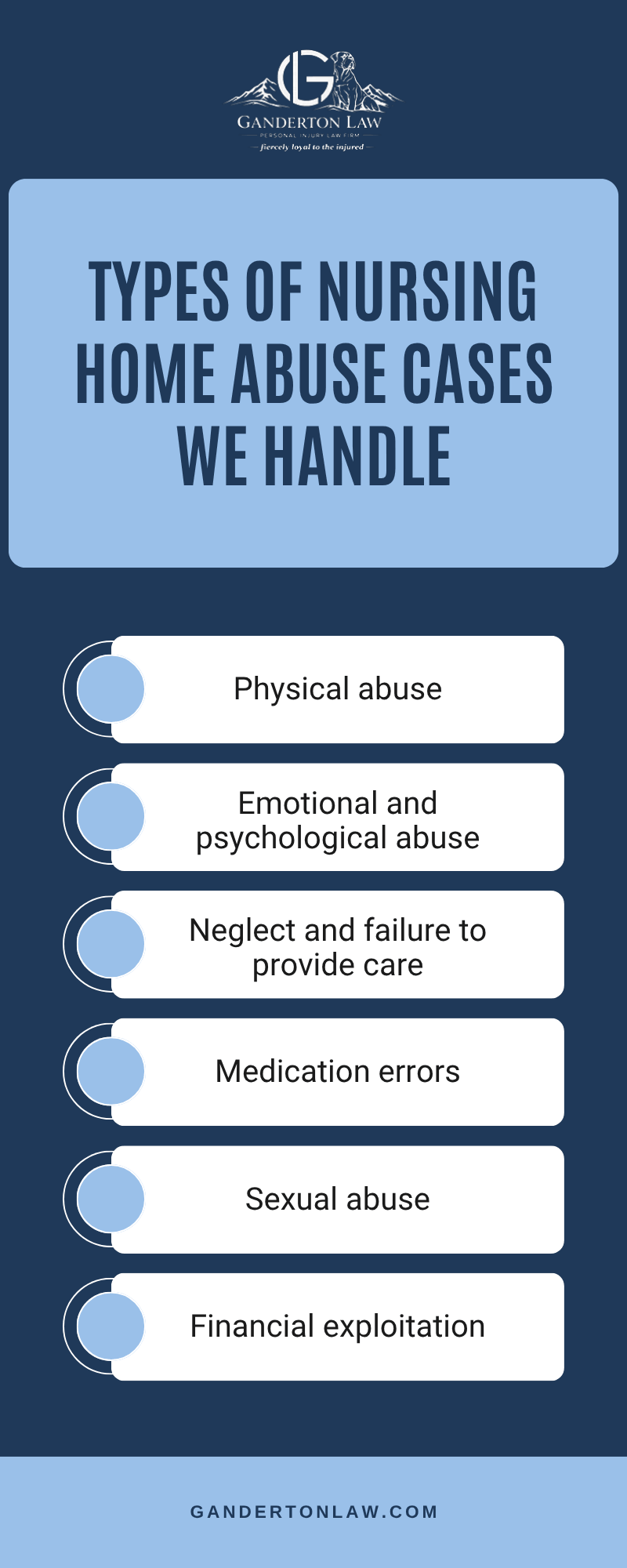
Nursing home abuse takes many forms. Some signs of mistreatment are visible, while others are more difficult to observe physically. Nursing home abuse can also entail financial exploitation or psychological harm that takes weeks or months to surface. Our firm handles the full range of abuse and neglect claims that arise in long-term care facilities throughout Colorado Springs, CO.
- Physical abuse. This can involve unexplained bruises, broken bones, burn marks, or signs of restraint that facility staff can’t adequately explain. Physical abuse is often carried out by direct care workers and goes unreported because residents fear retaliation or worsened treatment if they speak out.
- Emotional and psychological abuse. Verbal threats, humiliation, isolation, or patterns of intimidation are all examples of psychological abuse. Residents with dementia or cognitive decline are especially vulnerable. This type of harm can be harder to document, but it’s still very real and needs intervention.
- Neglect and failure to provide care. Bedsores, malnutrition, dehydration, poor hygiene, untreated infections can all point to neglect and failure of proper care and attention. Neglect doesn’t require intent either, the only factor needed is that a facility failed in its duty to meet a resident’s basic needs.
- Medication errors. This can entail prescribing the wrong dosage, wrong drug, and/or missed doses. Medication mismanagement is among the most common forms of nursing home negligence and can cause serious or irreversible harm, including traumatic brain injuries from falls that occurred while a resident was over-sedated.
- Sexual abuse. Among the most devastating forms of nursing home abuse, and one that facilities often try to minimize or conceal. We handle these cases with the seriousness and discretion they require.
- Financial exploitation. Forged signatures, unauthorized account access, coercion around estate documents are examples of financial exploitation. Residents with cognitive impairments are especially vulnerable to being targeted monetarily.
Colorado Legal Requirements for Nursing Home Abuse
Colorado nursing homes are licensed and regulated by the Colorado Department of Public Health and Environment (CDPHE), which conducts unannounced annual surveys and investigates complaints involving quality of care, residents’ rights, and abuse. Under C.R.S. § 25-1-107.5, the state has authority to impose civil money penalties against facilities that create a direct threat to resident health, safety, or welfare.
Residents in licensed Colorado nursing facilities hold specific legal protections. The law requires facilities to meet both state licensing requirements under 6 CCR 1011-1 Chapter 5 and federal standards for Medicaid and Medicare participation. Violations can form a direct basis for a civil negligence claim.
Families who suspect abuse in Colorado Springs should know that reports can be filed with CDPHE’s Health Facilities division. The Colorado Attorney General’s Medicaid Fraud Control Unit also investigates abuse and neglect in facilities that receive Medicaid funding.
The statute of limitations for personal injury claims in Colorado is generally two years from the date the injury was discovered or reasonably should have been discovered, under C.R.S. § 13-80-102. By missing this deadline, it typically voids the possibility of pursuing compensation. If you think something happened to your loved one, waiting is one of the costliest mistakes a family can make. The time to act for a relative’s best interests and to meet the statute of limitations for cases like these, is now.
What Damages Are Recoverable in a Colorado Springs Nursing Home Abuse Case?
Families who bring successful nursing home abuse claims in Colorado may recover several categories of damages.
Economic damages cover the direct financial losses from the abuse or neglect. This includes medical expenses for treating injuries the facility caused or allowed to worsen, costs to relocate a resident to a safer facility, and any out-of-pocket expenses that were incurred from the harm. Where a resident passed away as a result of abuse or neglect, economic damages may include funeral costs and related expenses.
Non-economic damages addresses harm that isn’t measured in receipts. Pain and suffering, emotional distress, and loss of enjoyment of life are all examples of non-economic damages that may be awarded. For a nursing home resident, they may have spent time living in fear, chronic pain from preventable wounds, or enduring the psychological toll of being mistreated by people who were supposed to protect them. Colorado law allows recovery for this category of harm, though it involves legal analysis around caps that can apply depending on the type of claim.
Punitive damages are available in Colorado in cases where a defendant’s conduct was particularly willful, wanton, or egregious. Under C.R.S. § 13-21-102, punitive damages require clear and convincing evidence of conduct that goes beyond ordinary negligence. In nursing home cases involving deliberate concealment of abuse, patterns of repeated violations, or knowing disregard for resident safety, punitive damages may be appropriate. They serve to punish, not just compensate, and can significantly affect the final value of a claim.
Understanding what you’re entitled to recover after nursing home abuse is the first step. Proving those damages requires thorough documentation, facility records, medical records, and often expert analysis. That’s the work Attorney Ganderton and his team are committed to handling for victims and their families.
Contact Ganderton Law Personal Injury Law Firm
If your family member was harmed in a Colorado Springs nursing home, don’t wait to intervene for their safety. We offer free and confidential consultations, and take nursing home abuse cases on a contingency fee basis. That means there are no upfront costs and no payment required unless we win. We’ll listen, answer your questions, and explain your options. Contact us today to tell us what happened.
Colorado Spring Nursing Home Abuse Infographic
Nursing Home Abuse Statistics in Colorado Springs
 Nursing home abuse is more common than most families realize, and a great deal of it never comes to light. The National Institute on Aging reports that hundreds of thousands of adults over 60 are abused, neglected, or financially exploited every year. The Department of Justice estimates that roughly one in ten adults over 60 experiences some form of abuse each year, and that only a small fraction of cases are ever reported. The CDC likewise treats elder mistreatment as a serious, underrecognized public health problem. Residents living with dementia face the highest risk because cognitive decline makes it harder to recognize or describe what is happening. Behind each of these numbers is a person who trusted a facility to keep them safe, and a family that deserves answers when that trust is broken.
What Are Common Types of Injuries in a Nursing Home Abuse Case?
Abuse and neglect inside a care facility can leave marks that range from obvious wounds to quiet, internal harm. Some injuries surface within hours. Others build slowly over weeks, hidden beneath a blanket or written off as ordinary aging. Recognizing them is often the first step toward protecting a loved one. These are the injuries we see most often in nursing home abuse claims throughout Colorado Springs.
- Bedsores and pressure ulcers. These open wounds form when a resident is left in one position for too long, cutting off blood flow to the skin. They are almost entirely preventable with regular repositioning. Advanced sores that reach muscle or bone are among the clearest signs that basic, routine care was neglected. Caught early, they are treatable, but left unchecked they can expose bone and become life-threatening.
- Broken bones from falls. Falls are the leading safety problem in long-term care, and a resident’s slip and fall can fracture a hip, wrist, or pelvis. Many of these falls trace back to understaffing, wet floors, missing handrails, or a failure to assist residents in getting up and moving safely.
- Head and brain trauma. A fall, a drop during a transfer, or a physical assault can cause bleeding and swelling inside the skull. In older adults, even a seemingly minor blow can have lasting effects on memory, balance, and daily functioning, and the symptoms sometimes do not appear until days later.
- Spinal and back injuries. A hard fall or a careless transfer can cause spinal cord injuries, neck injuries, or serious back injuries that strip away a resident’s mobility and independence. These injuries frequently call for surgery and months of rehabilitation that an older body struggles to withstand, and full recovery is never guaranteed.
- Malnutrition and dehydration. When staff fail to help residents eat and drink, the results are rapid weight loss, weakness, sunken features, and confusion. Families often notice loose clothing or a sudden drop in alertness. Both conditions are dangerous on their own, slow healing, and make nearly every other medical problem worse.
- Infections and sepsis. Untreated bedsores, unsanitary conditions, and ignored symptoms can let an infection spread into the bloodstream. Sepsis moves quickly in older patients, and when staff miss the early warning signs or delay treatment, an infection that should have been manageable can turn fatal.
- Burns and scald injuries. Bathwater that is too hot, spilled food and liquids, and unsafe equipment can leave residents with painful burns. Scald injuries during bathing are especially common when staff rush or fail to check the water temperature. A resident who cannot move quickly or call for help is at the greatest risk.
- Catastrophic and fatal outcomes. Some residents suffer catastrophic injuries that change their lives permanently and demand around-the-clock care. When abuse or neglect leads to a resident’s death, the family may pursue a wrongful death claim against the facility and others who failed in their duty.
Colorado Springs Nursing Home Abuse Lawyer FAQs
Families come to us with the same worries and questions, often while they are still deciding whether something is truly wrong. Below are answers to the questions we hear most.
How can I tell the difference between abuse and normal aging?
Some decline comes with age, but sudden changes deserve a closer look. Unexplained bruises, rapid weight loss, withdrawal, fear around certain staff, bedsores, or missing money are not normal parts of getting older. If a loved one seems different and the facility cannot explain why, it is worth pressing for clear answers and documenting your observations along the way.
What should I do first if I suspect my loved one is being mistreated?
Start by making sure they are safe and that they are getting any needed medical care. Write down what you saw, take photographs of injuries or conditions, and note dates and names. Report your concerns to the facility and to the proper authorities. Keep copies of everything. Early documentation often makes the difference in showing what happened and when.
Can I move my family member to a different facility during a case?
Yes. You are never required to leave a loved one somewhere you believe is unsafe. Moving them does not end your right to pursue a claim for harm that already occurred. We often encourage families to focus first on safety and proper care, then turn to holding the facility accountable for what took place.
How do we prove a nursing home was responsible?
Building a case means proving negligence: showing the facility owed a duty of care, failed to meet it, and caused real harm as a result. We gather medical records, staffing logs, inspection histories, and witness accounts. Patterns often carry the most weight, since a facility with repeated violations or chronic understaffing reveals a system that sets residents up to be hurt.
Who can be held liable for nursing home abuse?
Responsibility can extend well beyond a single employee. The facility itself may be liable for negligent hiring, poor training, or dangerous staffing levels. In some situations, a corporate parent company that cuts budgets at the expense of care shares the blame. Identifying every responsible party matters because it affects both accountability and the compensation available to your family.
What does it cost to hire a nursing home abuse lawyer?
There is no upfront cost to work with our firm. We handle nursing home abuse cases on a contingency fee basis, which means our fee comes out of a recovery only if we obtain one for your family. The initial consultation is free and confidential, so you can understand your options before making any decisions. This arrangement lets families pursue accountability without worrying about hourly bills while a loved one still needs care.
How long do I have to file a nursing home abuse claim in Colorado?
Colorado law sets deadlines for bringing an injury claim, and the time available depends on the type of harm and when it was discovered. Because some abuse and neglect come to light long after it began, the date a family learns of the harm can matter. Waiting too long can bar a claim entirely, so it is worth speaking with an attorney early. We can review the timeline in your situation and explain how the deadline applies to your family’s circumstances.
Will I owe taxes on a nursing home abuse settlement?
Compensation for physical injuries is generally not taxed, but the answer depends on the types of damages involved. Whether a settlement is taxable can change when a recovery includes punitive damages or certain other categories. We are not tax advisors, so we encourage families to confirm details with an accountant, but we can explain how a recovery is typically structured.
What questions should I ask before hiring an attorney?
Ask about experience with injury and neglect claims, who will handle your case, and how the firm communicates. It helps to prepare questions to ask so you leave the meeting with a clear sense of the road ahead. You want a firm that listens, explains things plainly, and treats your family as people rather than a file number.
How do I prepare for a free consultation?
Useful items include medical records, photographs, the facility’s name and admission paperwork, and a written timeline of your concerns. Reviewing a few common questions beforehand can help you make the most of the meeting. Do not worry if your records are incomplete. Part of our job is finding the documents and information that you cannot get on your own.
Local Information for Colorado Springs Nursing Home Abuse Cases
Families in the Pikes Peak region do not have to face these situations without support. Several organizations can help you report concerns, protect a loved one, and understand a resident’s rights.
What Are Important Local Resources for Colorado Springs Nursing Home Abuse?
If you believe a resident is in immediate danger, call 911 first. Beyond that, the following organizations help Colorado Springs families address abuse and neglect in long-term care.
- Colorado State Long-Term Care Ombudsman Program. Phone: 303-862-3524. A free, confidential advocate for residents of nursing homes and assisted living facilities, with a local office in Colorado Springs.
- Colorado Adult Protective Services. Phone: 1-844-264-5437. Receives and investigates reports of abuse, neglect, or exploitation of at-risk adults statewide.
- Pikes Peak Elder Justice Center. Phone: 719-318-7459. A Colorado Springs organization that helps victims of elder mistreatment find safety and support.
We share these resources for your convenience. Listing them is not an endorsement, and each organization operates independently of our firm.
About Ganderton Law Personal Injury Law Firm
Our firm stands with injured people and their families, never the facilities or insurers on the other side. Founder David Ganderton leads a plaintiff-side personal injury practice and is admitted to the bar in Colorado, Wyoming, and Florida. Over the years, the firm has recovered millions for clients across Colorado. Holding a nursing home accountable takes careful investigation and persistence, and that is what we bring to every claim.
What Our Clients Say
⭐⭐⭐⭐⭐
“I found this law group after my husband was involved in a terrible accident due to the fault of a local mechanical establishment who failed at the job and almost cost my husband his life. I asked in a local facebook group for recommendations and I knew after our phone conversation immediately why Dave Ganderton at Ganderton law office came so highly recommended. This past year Dave, Sean, and team have been here for us through the turmoil this accident has created in our life. We are still fighting through it but I know they are the best for the job. I can’t thank them enough.”
Jessica Warren
Read more reviews on our Google Business Profile.
Contact Ganderton Law Personal Injury Law Firm
When a facility harms the person you trusted them to protect, you deserve to know what your family can do. We offer free and confidential consultations and handle nursing home abuse cases on a contingency fee basis, so there is nothing to pay upfront and no fee unless we recover for you. We will listen, walk you through your options, and explain how we can help. Contact us to tell us what happened, and we will respond promptly to talk through your next steps.
